Presidency of Religious Affairs (Diyanet) · since 2006
International Theology Programme (UİP)
A Diyanet-funded undergraduate education at one of Türkiye’s six faculties of theology, for young people who have finished secondary school in Belgium: accommodation, meals and tuition fees are covered by Diyanet; graduates go on to serve abroad as imams, academics and religious guides.
Applications for the 2026 session closed on 29 May 2026. The dates for the next session are announced each year, usually around February, by the Presidency of Religious Affairs (Diyanet) in a new guide; as soon as they are announced, they will be shared on this page and at our mosque. In the meantime, you can already meet our imam and start preparing for the interview (Qur’an recitation, religious knowledge).
6
faculties of theology
Ankara · Istanbul · Konya · Bursa
4 years
undergraduate study
+ preparatory year
387
scholarship students
from 14 countries (2026)
1,243
graduates
over 20 years
Promotional film
The UİP promotional film produced by the Presidency of Religious Affairs (Diyanet); the version published on the homepage of the Diyanet Foundation of Belgium (diyanet.be). The video only loads once you press play.
Other videos
Diyanet TV "Eksen İnsan" episode 121: the International Theology Programme (52 min, YouTube)
What is the programme?
The International Theology Programme (UİP) — officially the International Divinity Program (IDP) in Diyanet’s own English-language publications — is a scholarship programme set up and coordinated by the Presidency of Religious Affairs (Diyanet). It gives Turkish young people living abroad, as well as applicants not of Turkish origin, the opportunity to pursue undergraduate-level religious higher education at the faculties of theology in Türkiye [Guide 2026, p. 3]. Launched in 2006 at Ankara University’s Faculty of Theology, the programme is now offered at six faculties.
Applicants who meet the requirements and succeed at interview are placed in the faculties within the available quota; students follow the faculty’s curriculum and, on graduation, receive a Bachelor’s Degree in Divinity. The scholarship, accommodation and tuition costs are covered by the Turkish Diyanet Foundation (TDV); the Diyanet Foundation of Belgium also provides additional support to students from the region.
The programme’s five objectives
- To train religious-service personnel with a close understanding of the religious and cultural needs of the community living in Europe.
- To train educators able to deliver formal and non-formal religious education using sound methods.
- To train people capable of providing guidance in processes of social integration.
- To build a body of personnel able to convey accurate religious knowledge that dispels prejudice.
- To develop qualified academic human resources in the field of religious sciences.
What is provided?
Once enrolment is complete and the scholarship undertaking is signed, the student benefits from the following support [Guide 2026, p. 5-8]:
Scholarship
Monthly financial support (the amount is set each year by the Presidency; the guide gives no figure).
Accommodation
Free lodging in Turkish Diyanet Foundation (TDV) dormitories, for the whole academic year.
Meals
Catering support (dormitory and faculty cafeterias).
Tuition fees
The faculty’s basic education costs are covered by the Presidency.
Not covered: transport (airfare), books and stationery, and health insurance are the student’s responsibility [p. 6].
A deposit of €1,000 is collected from the student at final enrolment; it is refunded to a student who completes the programme as a scholarship holder, but is not refunded to one who leaves the programme before completion or is dismissed for breaching the scholarship undertaking [p. 20].
Vocational training and internships
- Practical religious service at the mosque: serving as imam and muezzin, Friday prayer and the sermon (khutbah).
- Practice in Qur’an courses; preaching (vaaz) and religious oratory.
- Spiritual-support internship: prisons, retirement homes, children’s homes, hospitals, youth centres.
- Practice at the mufti’s office (the Alo Fetva telephone fatwa service, the Family and Religious Guidance Office), funeral services.
- During the summer break, in the student’s country of residence, an internship at a mosque and association coordinated by the Counsellor’s office; a certificate is issued at the end.
Supplementary training (participation compulsory)
- Arabic courses
- Qur’an and tajwid
- Basic Islamic studies courses (exegesis, hadith, Islamic law, theology)
- Religious music
- Thematic seminars and workshops
Sociocultural life
- Trips, summer and winter camps
- Student club activities
- Volunteering projects
- Graduation programmes
Six faculties of theology
The language of instruction is Turkish; where needed, placement in an English-medium theology programme is possible. The undergraduate degree lasts 4 years excluding the preparatory year (8 semesters). The preparatory year is compulsory and mainly focused on Arabic; students who do not know Turkish also take a one-year Turkish preparatory course [Guide 2026, p. 10].
Ankara University Faculty of Theology
Ankara · 2006
Marmara University Faculty of Theology
Istanbul · 2007
Istanbul University Faculty of Theology
Istanbul · 2011
Necmettin Erbakan University Faculty of Theology
Konya · 2012
Uludağ University Faculty of Theology
Bursa · 2012
29 Mayıs University Faculty of Theology
Istanbul · 2012
Students who successfully complete the programme are awarded the Bachelor’s Degree in Divinity. Departments: Basic Islamic Sciences, Philosophy and Religious Sciences, Islamic History and Arts [p. 10-11].
Who can apply?
Application requirements from the 2026 guide [p. 14-15]; republished each year in a new guide.
- Having finished secondary school abroad, or being in the final year (the diploma must be recognised as equivalent to a Turkish high-school diploma).
- Being a citizen of the country of residence, a dual national, a Blue Card (Mavi Kart) holder, or holding permanent residence.
- Not having turned 25 as of 1 January 2026.
- Being unmarried.
- Not having studied, and not currently studying, in a theology programme in Türkiye.
- Not having previously been admitted to the programme and then dismissed, nor having been admitted but failed to enrol without a valid excuse.
This programme is not open to those who hold only Republic of Türkiye citizenship, holders of a high-school diploma issued by the Turkish Ministry of National Education, or graduates of the Open Education High School (Açık Öğretim Lisesi) [p. 15]. Applications are governed by the higher education institutions’ "Principles for the Admission of Students from Abroad."
2026 application calendar
Guide 2026, p. 15 and 18-19. The dates for the next session have not yet been published; in previous years, applications opened at the end of February and closed at the end of May.
| Step | Date |
|---|---|
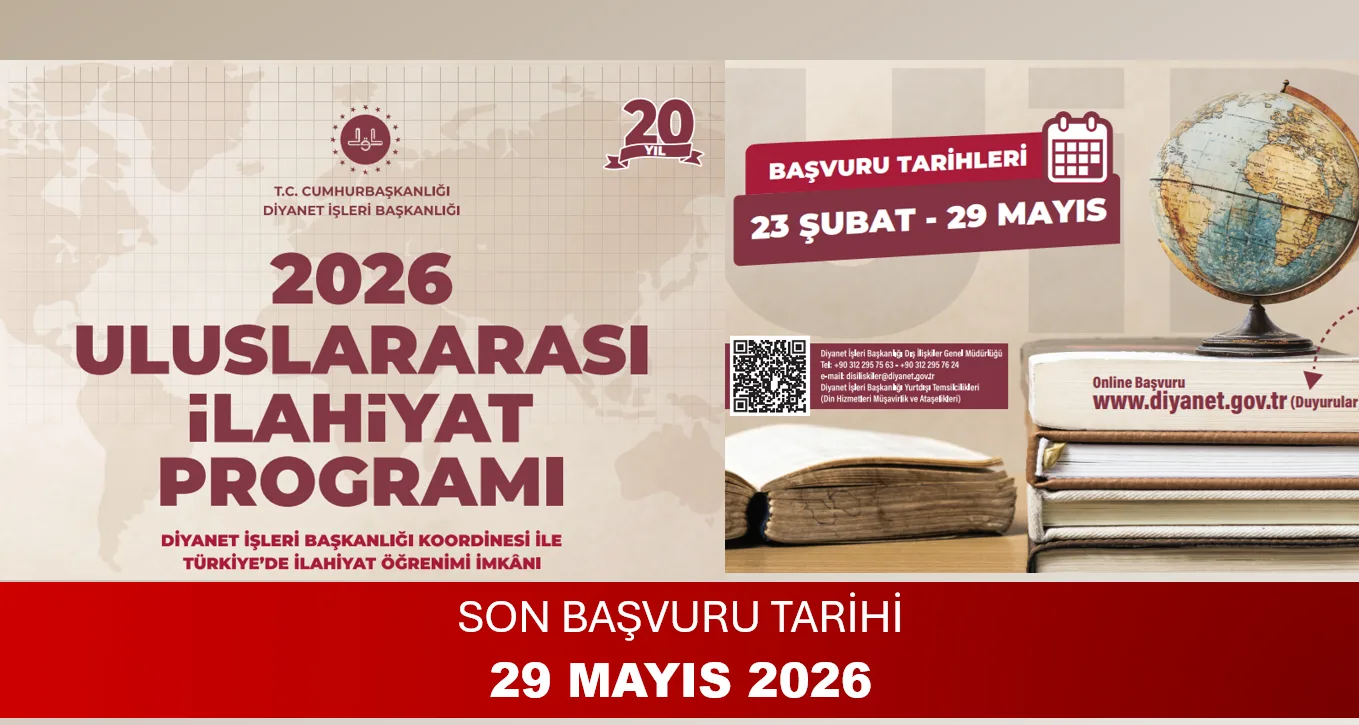
| Online application and document submission | 23 February – 29 May 2026 |
| Preliminary evaluation | May – June |
| Interview (in your country of residence, in person or online) | June |
| Announcement of results | July |
| Departure for Türkiye, orientation, start of classes | August – September |
How to apply
Six steps [Guide 2026, p. 16-17]. Until your documents are submitted, you can update your information using your application number.
Online form
Fill in the form on Diyanet’s application page (dibbys.diyanet.gov.tr); enter your email address correctly, as the interview invitation will be sent there.
Upload your documents
Upload your diploma or student certificate, equivalency certificate, ID/passport, residence permit, and signed scholarship undertaking to the system.
Letter of recommendation
Fill in the applicant’s section of the letter of recommendation and give it to our imam; he completes his own section and personally delivers the letter, in a sealed envelope, to the Counsellor’s office.
In-person submission
Submit photocopies of your documents, the printed application form, the scholarship undertaking and one photograph to the Office of the Social Affairs Counsellor in Brussels.
Confirmation
After a preliminary review, the Counsellor’s office activates your application in the system.
Do not miss the deadline
Applications received after the deadline are considered invalid.
Interview
Applicants who pass the Presidency’s preliminary evaluation are invited to an interview; the date and venue are communicated by email and can also be obtained from the Counsellor’s office. The interview is held in the applicant’s country of residence, in person or online; if necessary, the applicant may be invited to a centre in another country [p. 18-19].
Results are published on the application page using the applicant number; they can also be obtained from the Counsellor’s office.
Interview topics
- The Holy Qur’an (reading and memorisation)
- Religious knowledge (faith, worship, Islamic law, the Prophet’s life, ethics)
- General knowledge
- Turkish language proficiency
- Academic interest
The process in Belgium and our mosque’s support
In Belgium, applications are handled through the Office of the Social Affairs Counsellor (Religious Services) at the Embassy of Türkiye in Brussels. According to the letter sent by that office to association chairs and imams, the process works as follows [Counsellor’s office letter, 27 February 2024]:
- The programme is announced to the community at mosques and associations; the guide is given to those interested.
- The first section of the letter of recommendation is completed by the applicant, and the second and third sections by the imam; the letter is delivered to the Counsellor’s office in a sealed envelope.
- The scholarship undertaking is signed by the applicant.
- The application is submitted online; the required documents are delivered to the Counsellor’s office before the deadline.
Office of the Social Affairs Counsellor, Embassy of Türkiye in Brussels
Rue Montoyer 4, 1000 Bruxelles
Phone: +32 2 506 11 73
Contact details are taken from the Counsellor’s office letter dated 27 February 2024; confirm by phone before visiting.
How can our Grand Mosque help you?
- Our imam discusses the programme, the requirements and the interview topics with you one on one.
- He completes the imam’s section of the letter of recommendation and delivers it to the Counsellor’s office.
- We review your documents together and help you complete anything missing before the deadline.
- To prepare for the interview, we work together on Qur’an recitation and religious knowledge.
Required documents
Uploaded to the system when applying [p. 16]
- High-school diploma (for graduates).
- High-school diploma equivalency certificate (from the Embassy’s Education Counsellor).
- For final-year students: student certificate and transcript.
- Copy of a valid ID card or passport.
- Permanent residence certificate (for those who are not citizens of the country of residence).
- Signed scholarship undertaking.
At final enrolment, in Türkiye and in person [p. 20]
- The original high-school diploma and its Turkish translation, certified by a notary or a diplomatic mission.
- High-school diploma equivalency certificate.
- The original and a photocopy of the passport and ID card.
- Student visa (for those who are neither dual nationals nor Blue Card holders).
- 12 passport-style photographs.
Enrolment by post is not accepted; enrolment is not carried out with incomplete or uncertified documents. An applicant later found not to meet the requirements will not be enrolled, even if they passed the interview.
Scholarship undertaking
A student admitted to the programme accepts the following (2026 guide, p. 23 — summary):
Full text of the scholarship undertaking (PDF, guide p. 23)- Continuing studies at the faculty where placed; not requesting a transfer outside the applicable regulations.
- Complying with the regulations of the faculty and the programme.
- Not using addictive substances, and complying with the rules of moral conduct.
- Residing in the dormitory designated by the Presidency; any exception is subject to permission.
- Taking part in training, internship and seminar programmes.
- Staying away from political and ideological organisations.
- If studies are abandoned before completion, not being able to re-join the programme.
- Beginning to benefit from the support once the deposit is paid and the scholarship undertaking is signed.
- If the student withdraws after final enrolment, or is dismissed for a breach of the rules, the deposit is not refunded.
- Support being discontinued in accordance with the Scholarship Programmes Procedure and the Student Regulations.
After graduation
Career paths listed in the guide [p. 13-14]:
Serving as an imam abroad
Through an examination; successful candidates may serve in their own country or, if they meet the requirements, in another country.
Advanced Religious Specialisation
Those selected by interview continue their training at specialisation centres; graduates are appointed abroad as contracted imams (religious officials).
Mosque guidance
As foreign-language proficiency is required, UİP graduates have an advantage; this involves guiding foreign visitors to mosques.
Diyanet expertise
Expertise at the High Council of Religious Affairs and Religious Affairs expertise, by examination after serving as assistant expert.
Postgraduate study
Master’s and doctoral studies, in Türkiye or abroad; a TDV scholarship is possible.
Teaching and other paths
Those who complete a teaching qualification can teach religious culture, imam-hatip vocational subjects, and Arabic.
International Advanced Religious Specialisation Programme (UDYİP)
A separate programme that follows on from the UİP: it offers graduates of religious higher education Arabic preparation followed by specialisation in basic Islamic studies (per the 2026 announcement: 33 months in total; age limit of 35; applications from 9 February to 3 April 2026). UDYİP 2026 announcement (PDF)
Frequently asked questions
Who can apply?
Applicants who have finished secondary school abroad or are in their final year, who are citizens of their country of residence, dual nationals, Blue Card (Mavi Kart) holders or permanent residents, under 25 years of age, unmarried, and have not studied theology in Türkiye.
Can only Turkish citizens apply?
No, quite the opposite: only those who hold solely Republic of Türkiye citizenship and finished high school in Türkiye cannot apply. Any applicant who is a Belgian citizen or a permanent resident of Belgium may apply, whether or not they are of Turkish origin.
Do I need to know Turkish?
Turkish language proficiency is one of the interview topics; however, a one-year Turkish preparatory class is available for students who do not know Turkish. The language of instruction is Turkish.
Where do I apply?
You apply online on Diyanet’s application page; the documents are then delivered in person to the Office of the Social Affairs Counsellor in Brussels.
What is the mosque imam’s role?
He fills in his section of the letter of recommendation and delivers it, in a sealed envelope, to the Counsellor’s office; he reviews your documents with you and helps you prepare for the interview.
Where is the interview held?
In the applicant’s country of residence, in person or online. If necessary, the applicant may be invited to a centre in another country.
Is the programme fee-paying?
Tuition fees, accommodation and meals are covered by Diyanet; a monthly scholarship is paid. A deposit of €1,000 is collected at enrolment and refunded to those who complete the programme. Airfare, books and health insurance are the student’s responsibility.
How long does the programme last?
The undergraduate degree lasts 4 years; to this is added the compulsory preparatory year and, for those who do not know Turkish, a further one-year Turkish preparatory course.
Can a graduate return to Belgium as an imam?
The guide states that graduates who pass the examination may work as imams in their own country; appointment depends on passing the examination and on post availability.
When is the next application session?
The official date has not yet been published. In previous years, applications opened at the end of February and closed at the end of May; the final dates will be announced in Diyanet’s new guide and updated on this page.
Can girls apply as well?
Yes. The programme is mixed; the guide lists separate dormitories for girls (Ankara and 29 Mayıs) and for boys (Bursa and Konya) (2026 guide, p. 5).
If I am not accepted this year, can I apply again?
Yes. The guide only bars candidates who were previously admitted and then dismissed, or who were accepted but failed to enrol without a valid excuse, from applying again [Guide 2026, p. 15, item 5]; there is no bar on a future application for someone not selected at interview this year.
Documents and links
Official documents setting out the application procedures and conditions. The guide has been compressed for the web; the original is published on diyanet.be.
- 2026 UİP Presentation and Application GuidePresidency of Religious Affairs (Diyanet) · 40 pages · requirements, timeline, steps, documents, scholarship undertaking, faculties, careersPDF · 2.5 MB
- Scholarship Undertaking (2026)Guide, page 23 · signed and uploaded to the system when applyingPDF · 72 KB
- Letter of Recommendation (sample, 2024 version)Applicant and imam sections · obtain the current version from our imam or the Counsellor’s officePDF · 50 KB
- Brochure 2026 — FrenchProgramme international de théologie · 2 pagesPDF · 825 KB
- Brochure 2026 — EnglishInternational Divinity Program · 2 pagesPDF · 826 KB
- Brochure 2026 — GermanInternationales Theologieprogramm · 2 pagesPDF · 820 KB
- UDYİP 2026 announcementInternational Advanced Religious Specialisation Programme · post-graduation specialisationPDF · 708 KB
Official links
- Online application page (dibbys.diyanet.gov.tr)
- Diyanet Foreign Relations — UİP 2026 announcement
- Diyanet Foundation of Belgium — UİP applications
- Original guide (diyanet.be, 22 MB)
- Diyanet Foundation of Belgium — education scholarship (Fitre-Zakat Fund)
- Presidency of Religious Affairs (Diyanet) announcements
- Turkish Diyanet Foundation (TDV)
Related scholarship: Diyanet Scholarships (TDV)
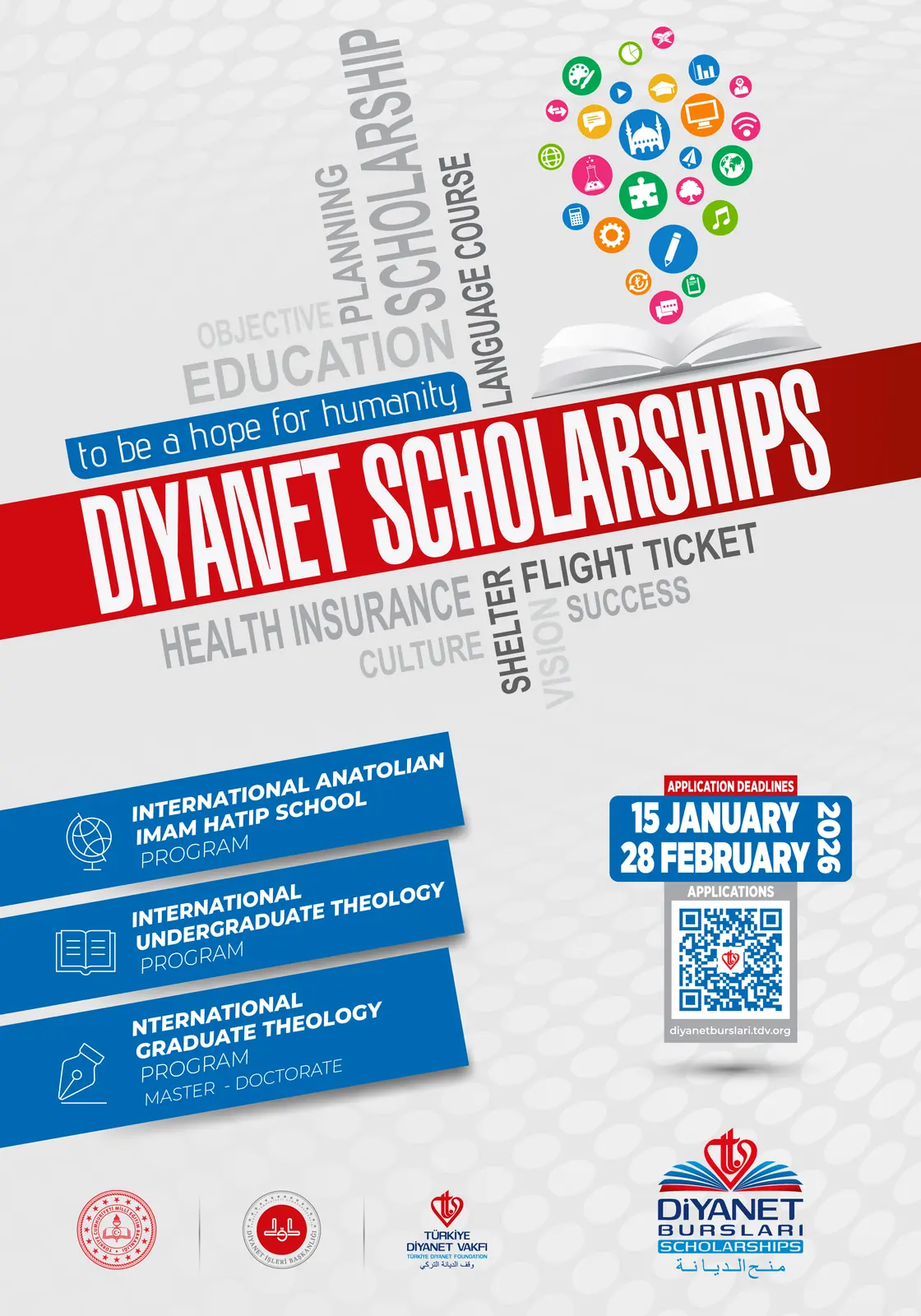
The Turkish Diyanet Foundation’s (TDV) "Diyanet Scholarships" programme for international students runs on a separate application calendar, at imam-hatip high school, undergraduate and postgraduate theology levels (2026 applications: 15 January – 28 February). Details and application: diyanetburslari.tdv.org. diyanetburslari.tdv.org
Posters (click to enlarge)
Information and application support
Young people interested in the programme and their families are welcome to visit our mosque or call our imam. The meeting is free of charge; act early for the letter of recommendation.